Is Snorkelling On The Gold Coast Safe?
A source-based look at Gold Coast snorkelling safety: operator swim rules, life jackets, stinger facts from Surf Life Saving Queensland, shark control equipment, weather cancellations and the Tangalooma current warning.
Safety on the covered Gold Coast snorkel tours is built from specific, checkable measures rather than one blanket rule: every operator sets its own swim requirement, two of the seven (both Wave Break kayak trips) welcome non-swimmers with life jackets, the Cook Island turtle trips cap groups between 9 and 12, and every booking page lists free cancellation up to 24 hours when conditions turn. What no source gives is a verdict, and this page will not invent one. Instead it lays out what the operators themselves state, what Surf Life Saving Queensland says about stingers, what Queensland's shark control program covers, and where the one documented current warning applies, so you can match a trip to your own swimming ability.
Start with the single most useful fact for a nervous snorkeller: the covered trips split into two very different experiences. The Wave Break Island trips run inside the Gold Coast Broadwater, a sheltered body of water behind the Seaway walls, and the two kayak-and-snorkel operators there, Seaway Kayaking Tours and AKA Adventures, both explicitly welcome non-swimmers who wear life jackets. The Cook Island turtle trips on the New South Wales side are open-water ocean snorkels: all three operators there require confident swimmers, with stated distances of 50, 100 and 200 metres unassisted. That is the real safety dividing line on this coast, and it comes straight from the operators' own pages.
The site exists to help you make exactly this call.
For readers deciding between the sheltered and open-water options, the guide to snorkelling the Gold Coast with kids covers the family-side eligibility rules in more depth, and whether non-swimmers can snorkel here handles the life jacket question in full.
Who Can Go: Swim Rules, Ages And Life Jackets By Operator
Every covered operator sets its own eligibility, and the differences are large: minimum ages range from 4 to 7 where stated, swim requirements range from none at all to 200 metres unassisted, and life jackets are mandatory in the water on the two kayak trips but not worn by Cooly Eco Adventures in the water, while Watersports Guru supplies a lifejacket and flotation device. AKA Adventures prints no minimum age because its booking pages conflict, and Queensland Scuba Diving Company states no age or swim requirement at all. There is no single Gold Coast standard, so read your operator's row, not a friend's story about a different tour.
- Marine Biologist Guide, Cook IslandUS$93.64
- Cook Island Turtles From ChinderahUS$116.52
- Small Boat, Fingal Head TurtlesUS$120.59
Seaway Kayaking Tours is the most open of the seven: from age 4, under 16s with an adult, no swimming, kayaking or snorkelling experience needed, and life jackets are worn in the water, which is why non-swimmers are welcome. AKA Adventures matches that life jacket policy, worn at all times on the water, and also welcomes non-swimmers. The three Cook Island operators sit at the other end. Cooly Eco Adventures requires an unassisted 50 metre swim and does not wear life jackets in the water. Watersports Guru requires the length of a 100 metre pool and states plainly that its trip is not for non-swimmers. Blue Seafaris is the strictest of the three: 200 metres unassisted, confident in open water, reasonable fitness, minimum age 7, under 16 with an adult, and no flotation jackets for non-swimmers, with pool noodles offered instead.
| Operator | Minimum age | Swim requirement | Life jackets / flotation |
|---|---|---|---|
| Seaway Kayaking Tours | 4 | None needed | Life jackets worn in the water |
| AKA Adventures | Not stated (listings conflict) | Non-swimmers welcome | Life jackets worn at all times on the water |
| Queensland Scuba Diving Company | Not stated | No experience necessary, instruction provided | Not stated |
| Cooly Eco Adventures | Not stated | 50 metres unassisted | Not worn in the water |
| Blue Seafaris | 7 | 200 metres unassisted, confident in open water | No jackets for non-swimmers; pool noodles offered |
| Watersports Guru | 6 | Length of a 100 m pool | Lifejacket and flotation device included in gear |
| See Moreton | Not stated | Not stated | Not stated |
The pattern worth noticing is that supervision scales with the water. The two Broadwater kayak trips can welcome everyone precisely because their groups stay clipped into life jackets beside a guide. The Cook Island operators, swimming in open ocean over a reef 600 metres from shore, use small groups instead: Watersports Guru caps its boat at 9 guests with an instructor and in-water guide, and Cooly Eco Adventures caps at 12. Blue Seafaris runs a marine biologist guide and describes its groups as small, though it prints no maximum. Small groups plus in-water guides are the safety mechanism you are actually paying for on a turtle tour, and if you want the full picture of how these trips run, the guide to Cook Island snorkelling from the Gold Coast breaks down each departure.
If the strict swim rules have made you hesitate about the ocean trips, the Wave Break Island kayak-and-snorkel format is the one designed around them.
Are There Sharks At Wave Break Island When You Snorkel?
No source states a shark presence, absence, incident or risk figure for Wave Break Island, and the Queensland shark control equipment list does not cover it: the listed Gold Coast locations are Burleigh, Kirra, North Burleigh, North Kirra, Palm Beach and Rainbow Bay, all ocean beaches, not the Broadwater site where these snorkels run. What the sources do say is that Wave Break Island is a man-made island in the sheltered Broadwater, described by the Gold Coast Waterways Authority as having clear, clean and mostly shallow waters. Anything beyond that would be invented, so take any extra safety claims with a grain of salt.
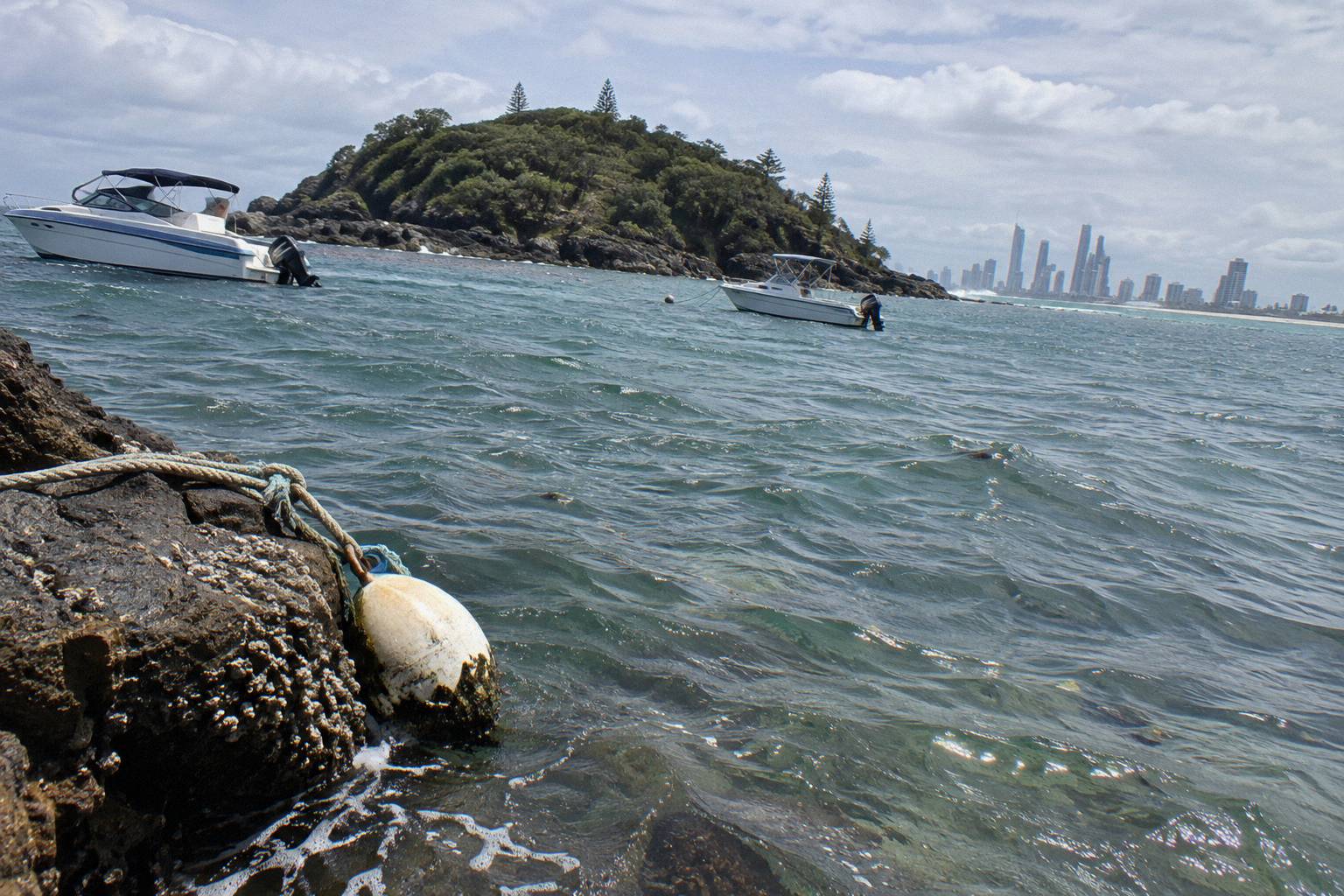
It helps to picture where you actually are on these trips. Wave Break Island was created in 1985 as part of the Gold Coast Seaway construction, and it sits inside the Broadwater behind the seaway walls, not on the open surf beaches where shark control equipment is installed. The site the snorkellers use is a man-made rock wall that has become a reef, reached after a roughly 30 minute paddle and a short bushwalk on the Seaway trip. The water is mostly shallow and protected from ocean swell, which is the entire reason it works for beginners, children from age 4 and non-swimmers in life jackets.
The honest answer to the question is therefore procedural rather than statistical. The operators brief each group, the groups are supervised, and the Queensland government's SharkSmart program publishes the equipment locations for the coast so you can see exactly which swim sites are covered. You can read the equipment list yourself on the Queensland Department of Primary Industries SharkSmart page. No incident claim or risk percentage exists in any source for this site, and a page that gives you one is guessing.
Stingers And Bluebottles: What Surf Life Saving Queensland Actually Says
Surf Life Saving Queensland states that dangerous tropical stingers, box jellyfish and irukandji, have a season typically running November through to May, but it places box jellyfish north of Agnes Water and irukandji north of southern Fraser Island, and it makes no presence or absence statement for the Gold Coast. Bluebottles, by contrast, occur Australia wide, and no Gold Coast bluebottle season or count exists in any source read. This page will not close a gap the authority leaves open in either direction.
The practical detail worth knowing is first aid, because it is specific and it is official. For a bluebottle sting, SLSQ says to remove any tentacles, rinse with sea water, then apply hot water for about 20 minutes, no hotter than comfortable, with a cold pack if pain is unrelieved. For tropical stingers the treatment is vinegar, and in an emergency you call 000. That is the full extent of what the authority publishes, and it is worth having in your head before any Australian beach day, snorkel tour or not. The details are on the SLSQ marine stingers page.
On the operator side, the sources are quieter than you might expect. None of the seven covered tours publishes a stinger suit policy in the material read; Blue Seafaris and Watersports Guru both include wetsuits in their gear, and Seaway Kayaking Tours lists hot drinks in winter. Wetsuit thickness, stinger suit hire and season timing advice simply are not in the sources, so the right move is to ask the operator directly when you book, rather than trust a checklist a blog made up. Our longer treatment of this topic, stingers and bluebottles on the Gold Coast, keeps to the same limits.
Sharks And Snorkelling On The Gold Coast: The Real Picture
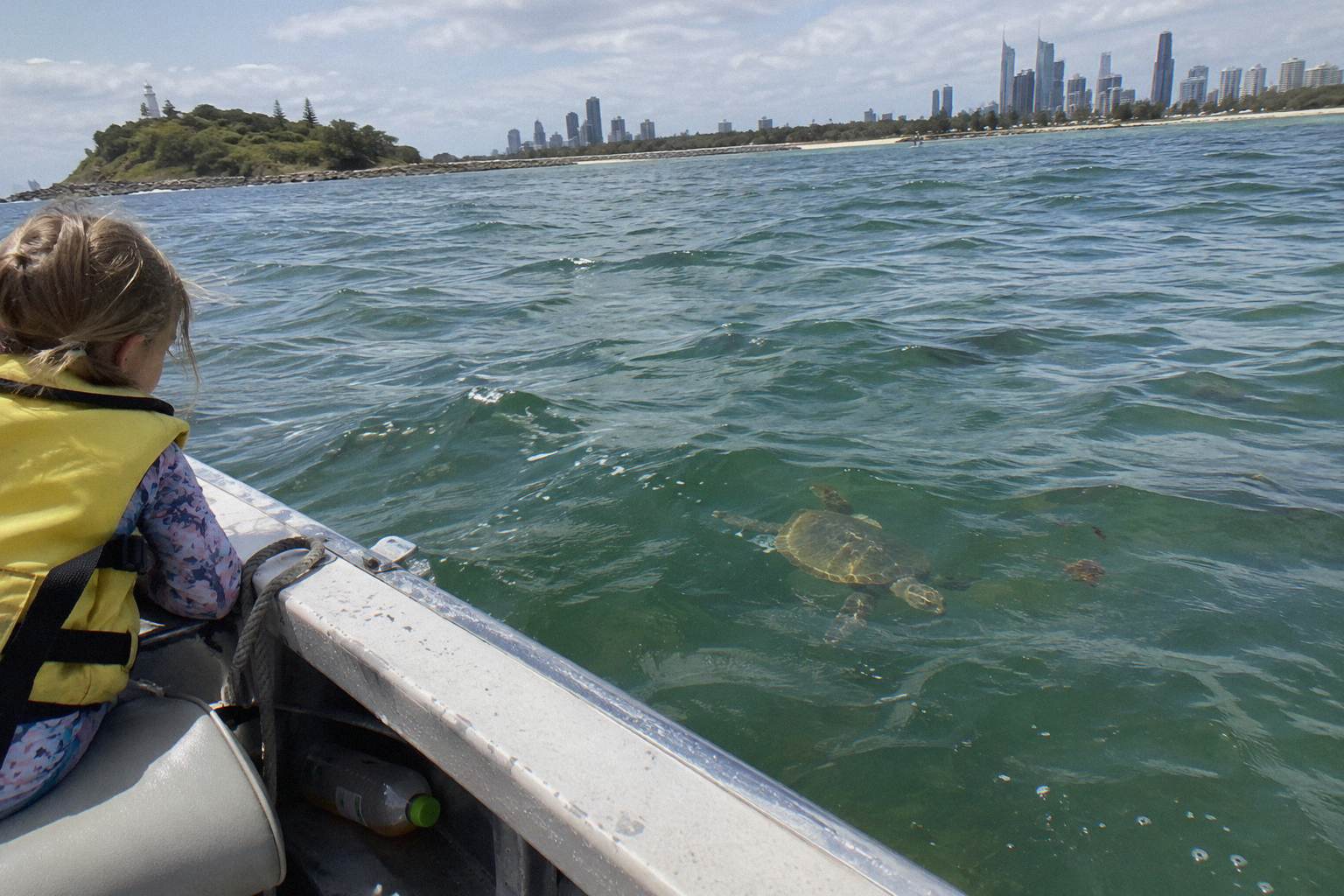
The real picture from the sources is three separate facts: Queensland lists shark control equipment at six named Gold Coast ocean beaches; NSW DPI lists grey nurse sharks among the threatened species at Cook Island Aquatic Reserve; and Blue Seafaris lists leopard sharks as seasonal marine life there, while Cook Island and Wave Break Island are both outside the shark control equipment list. No source states an incident, a risk percentage or a safe verdict for any covered site, and none appears here. What the sources do show is that the sites where these tours snorkel are managed places: a no-take aquatic reserve with a 4 knot speed limit and operator code of conduct on one side, a sheltered constructed island on the other.
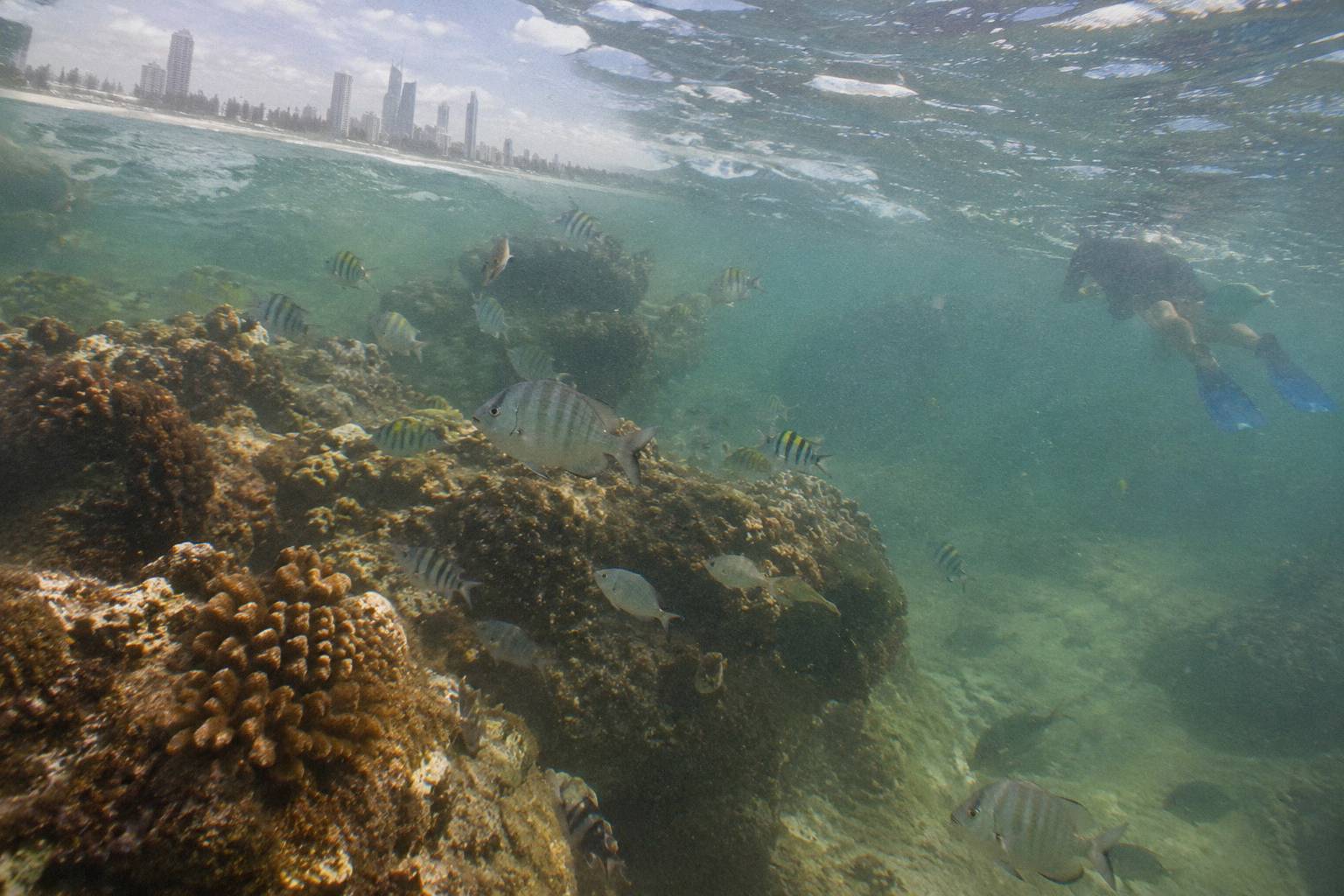
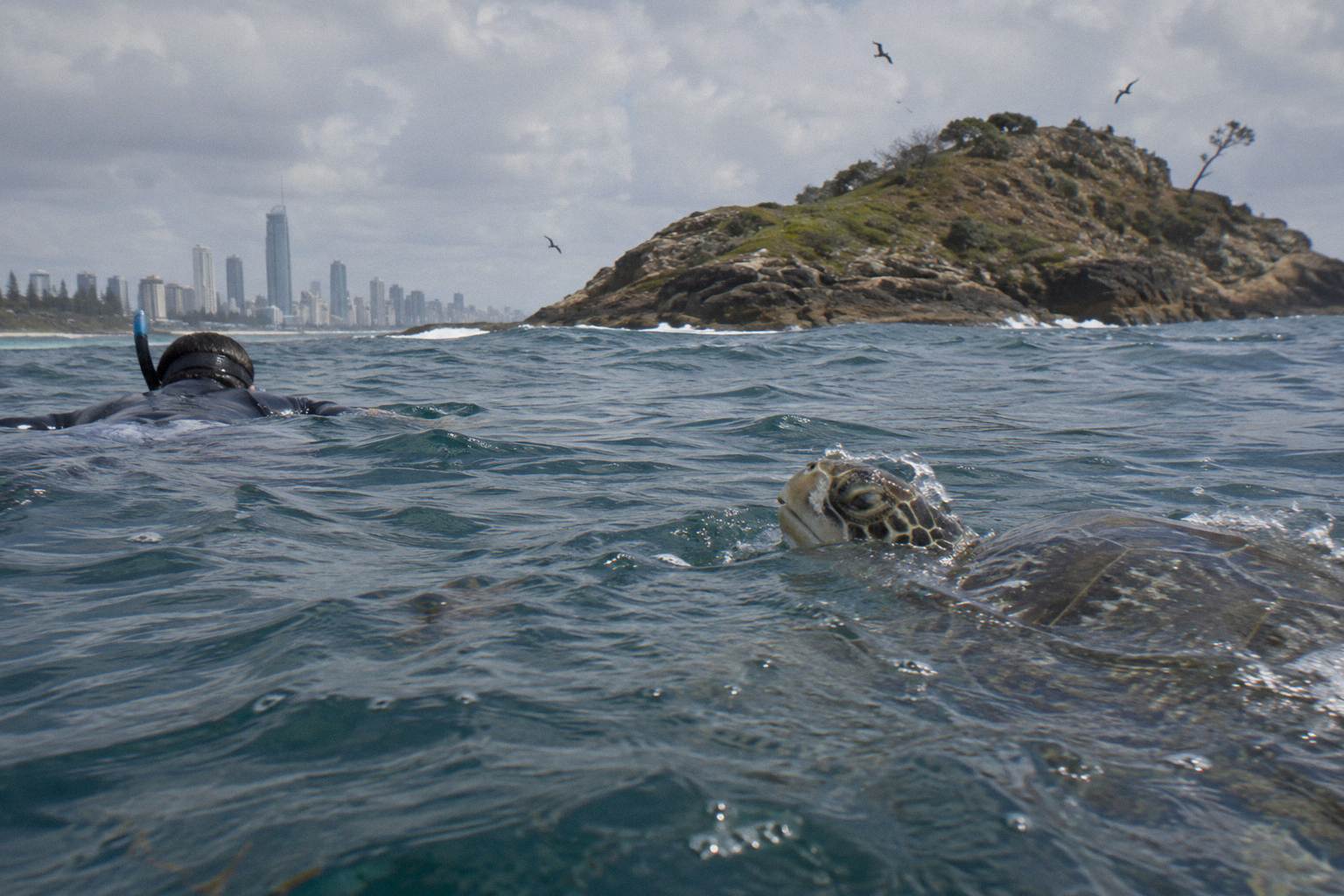
The Cook Island facts deserve their own sentence because they are the most concrete shark information anywhere in the sources. The NSW Department of Primary Industries describes the reserve as a hotspot for threatened green, hawksbill and loggerhead turtles, and lists the giant Queensland groper and the grey nurse shark among its threatened species. Grey nurse sharks are a protected species rather than a hazard statement, and DPI's reserve rules, no touching, chasing or disturbing marine life, apply to snorkellers too. The snorkel and dive operators working the island signed a Code of Conduct in 2023 and 2024 that includes a pre-dive briefing, which is exactly the mechanism that turns a group of strangers into a supervised one.
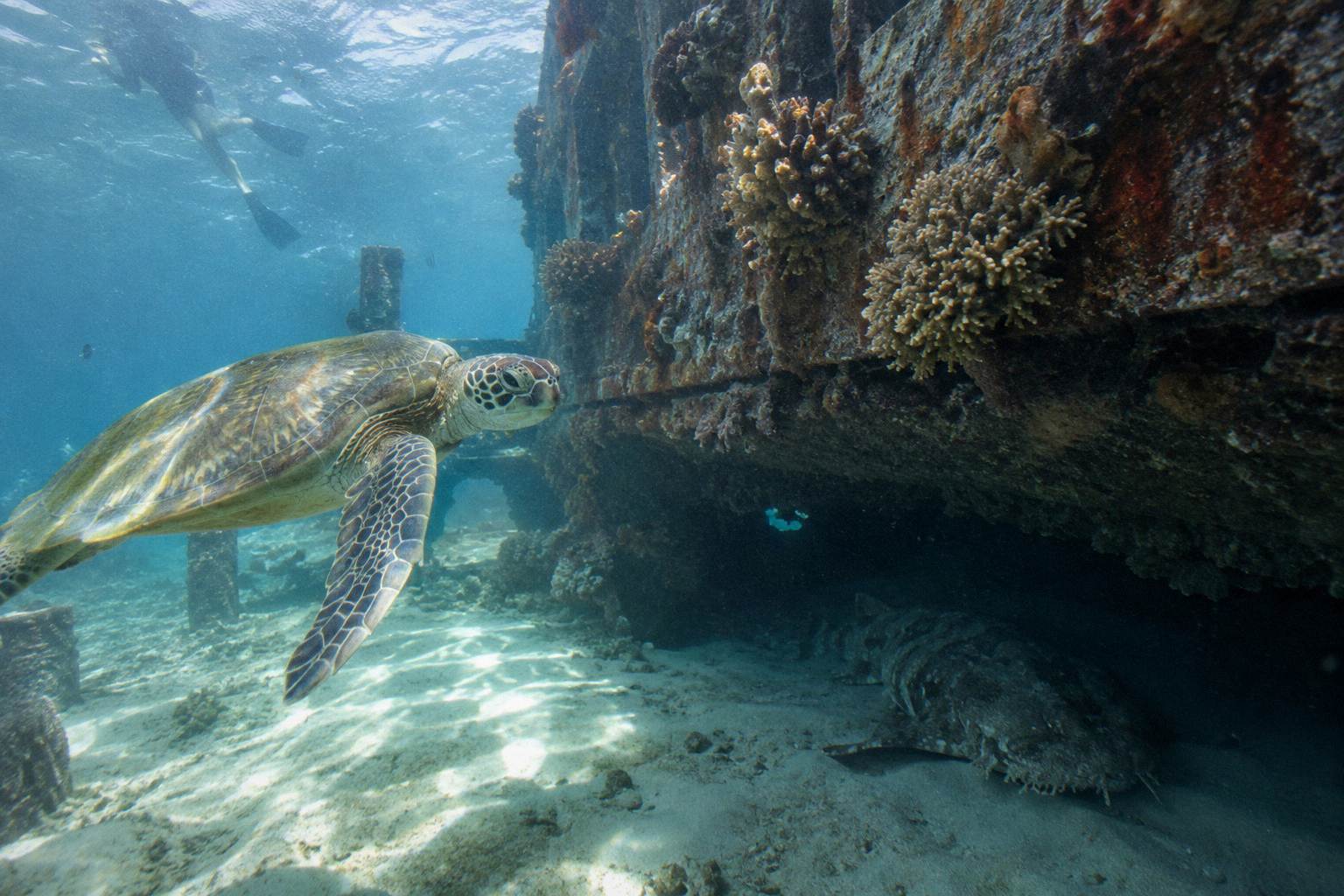
At Moreton Bay the framing shifts to turtle protection rather than shark risk. Queensland Parks says six of the world's seven marine turtle species are found in Moreton Bay, three of them resident, and that the species are vulnerable or endangered under state and federal law, which is why the marine park runs go slow areas for turtles and dugong. The Tangalooma resort's own wreck page mentions wobbegong sharks among the marine life, attributed operator wording about a site with over 200 fish species and 130 coral species. Read together, the sources describe a coast where sharks are a managed part of a protected ecosystem, briefings are standard practice, and no authority is issuing a safety verdict about them.
| Hazard | What the source states | Where it applies |
|---|---|---|
| Tropical stingers (box jellyfish, irukandji) | Season typically November to May; ranges north of Agnes Water and southern Fraser Island; no Gold Coast statement | Not stated for the Gold Coast |
| Bluebottles | Occur Australia wide; sea water rinse then hot water about 20 minutes | Australia wide |
| Grey nurse shark | Listed as a threatened species at the aquatic reserve | Cook Island |
| Leopard shark | Listed by the operator as seasonal marine life | Cook Island |
| Shark control equipment | Listed at Burleigh, Kirra, North Burleigh, North Kirra, Palm Beach, Rainbow Bay | Six Gold Coast ocean beaches; not the snorkel sites |
| Strong current | Runs between the wrecks and the beach when the tide runs; beach unpatrolled | Tangalooma wrecks |
That table is the whole shark and stinger picture the sources support, and it is deliberately free of percentages. For a longer trip built around the Moreton side, the Moreton Island snorkelling day trip guide covers the wrecks site in detail.
Currents, Weather Calls And What Happens When A Tour Cancels
The only current fact anywhere in the sources is Tangalooma's: the resort warns of a strong current between the wrecks and the beach when the tide runs, on an unpatrolled beach with boat and jet-ski traffic, and recommends the guided tour rather than swimming out. For Wave Break Island and Cook Island, no tide, current, rip or visibility figure has been published, so none can be given here. The safety system you can actually verify on those sites is the operators' weather judgement: Blue Seafaris runs daily subject to weather, tides and sea conditions, Watersports Guru runs weather permitting, and every covered booking page lists free cancellation up to 24 hours in advance for a full refund.
The two cancellation regimes are worth telling apart. The booking pages offer the 24 hour free cancellation on all seven covered products, and that is the basis you should rely on when booking. Blue Seafaris' own page adds different operator terms: guest changes by email at least 48 hours before, payment forfeited under 48 hours, and if the operator itself cancels for conditions, a credit voucher or a refund less booking and card fees. Presenting both is not a contradiction, it is two documents with two bases, and the instruction is simply to read the terms on the booking page before you rely on either. If weather cancels your day, the post on what happens when a snorkel tour is cancelled for weather works through the detail.
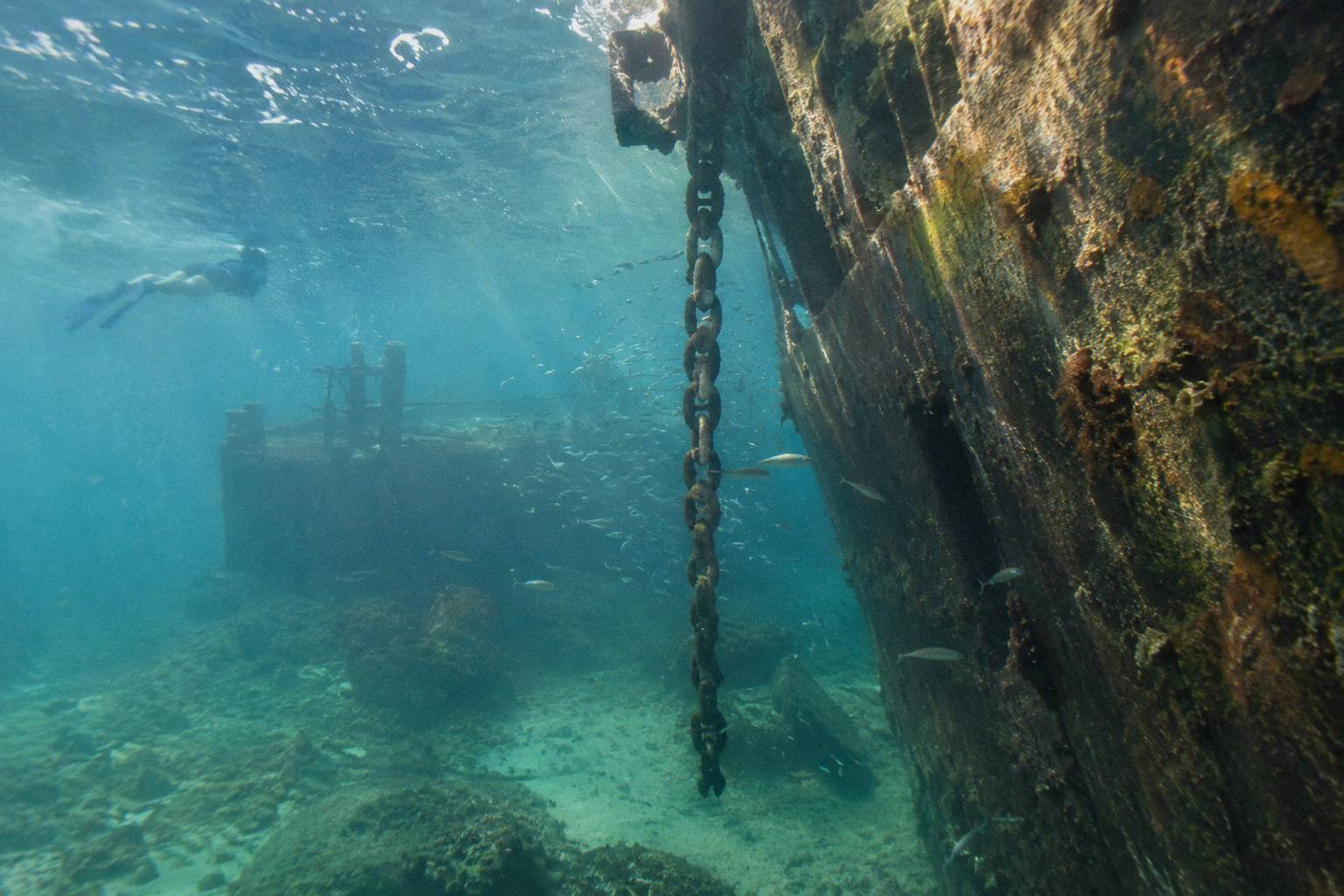
One warning travels with one site only, so it gets one clean statement: the Tangalooma wrecks current warning belongs to the Tangalooma wrecks, not to the Broadwater or Cook Island. The 15 vessels in the wrecks cluster were scuttled by the Queensland Government between 1963 and 1984, per the resort's own page, and the resort's guided-tour recommendation is the reason the covered Moreton product is a cruise with about 4 hours at the wrecks stop rather than a swim-from-the-beach arrangement. For the trips where you choose your own conditions, typical sea temperatures run about 22 in winter and about 26 to 27 in summer, which informs what you wear rather than whether you go; the month by month water temperature guide has the full table.
A Practical Safety Checklist Before You Book
Before booking any covered tour, check five things against the tables above: the operator's swim requirement, the minimum age, whether life jackets are worn in the water, the group maximum, and the cancellation basis, and where any of these is not stated, ask on the booking page rather than assuming the friendliest answer. Those five lines map directly onto the real differences between these products, and every one of them comes from an operator's own page or listing rather than from a generalisation about the coast.
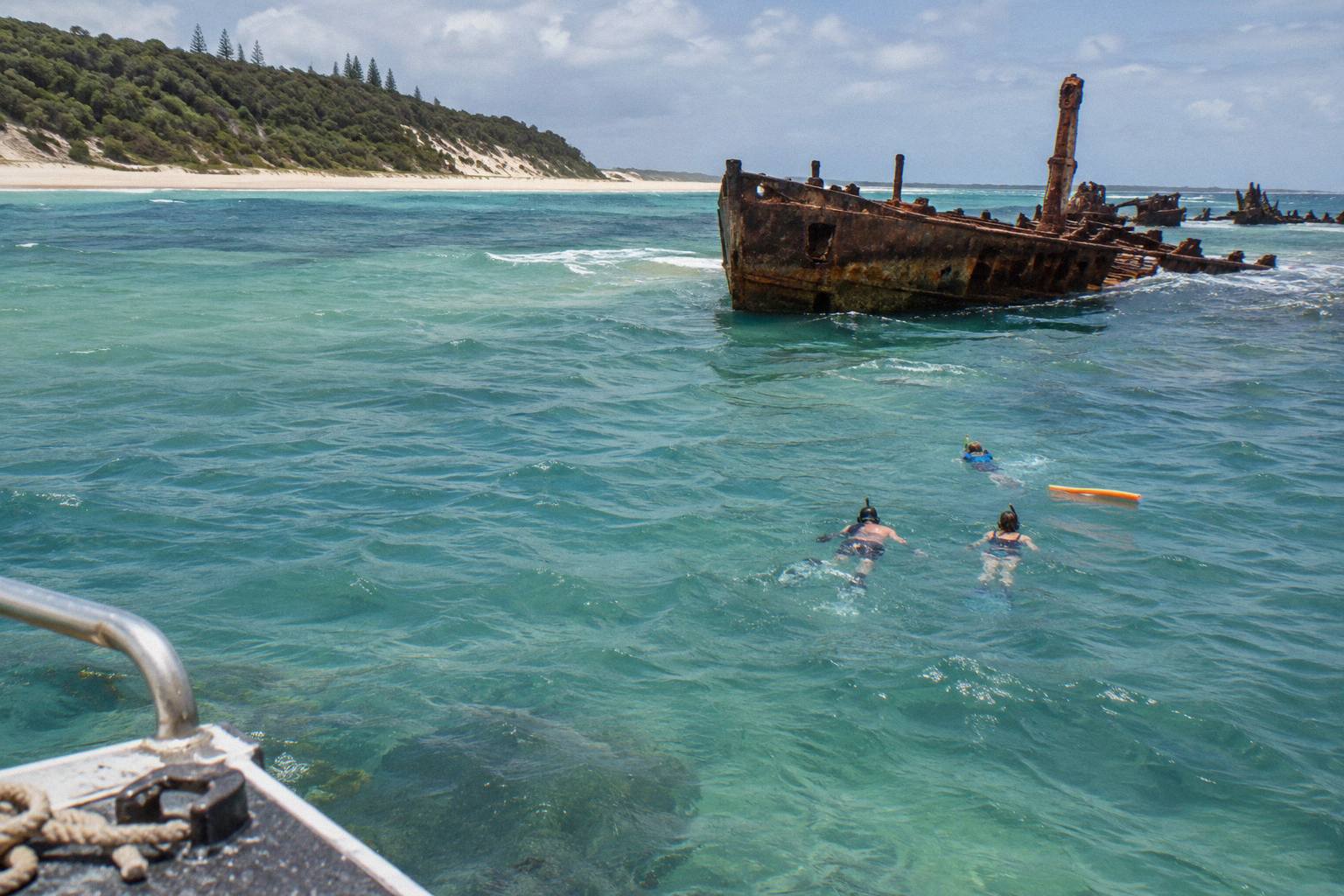
Match the product to the swimmer first, because that single decision does most of the safety work. A hesitant swimmer or a family with young children belongs on the Broadwater kayak format, where jackets are worn and the water is sheltered. A confident swimmer who wants turtles belongs at Cook Island, accepting the 50 to 200 metre requirement as the price of a small supervised group in open water. Someone with a full day and sea legs can take the Moreton cruise, which is a boat-based itinerary with a buffet lunch and transfers from selected Gold Coast hotels, and check the pickup point on the listing. And whatever you choose, book with the 24 hour free cancellation in mind, because conditions on this coast change and the operators reserve the right to call the day off.
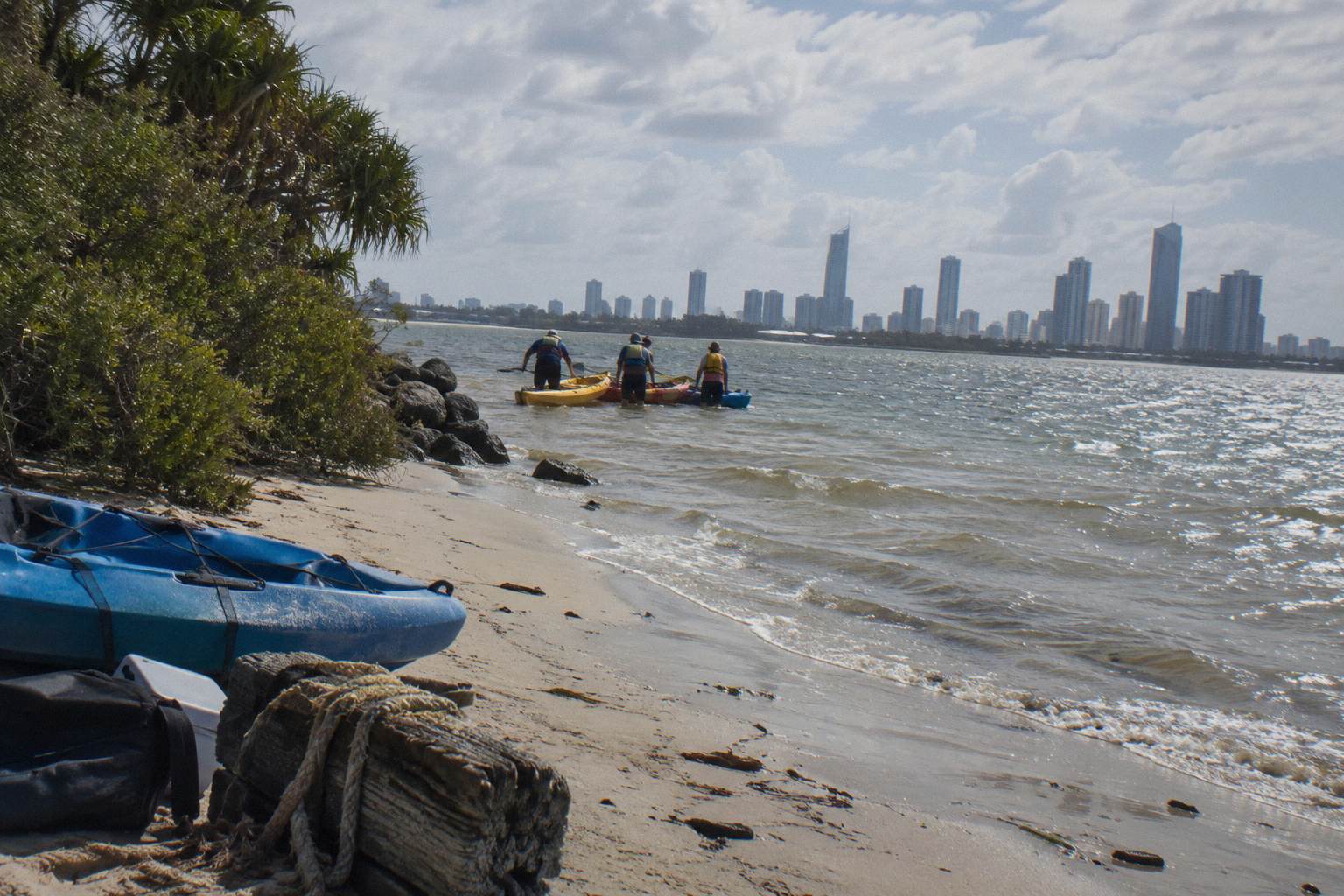
Between the operator rules, the official stinger and shark information and the weather terms, you now hold everything the sources contain.
Common Questions About Gold Coast Snorkelling Safety
Is Snorkelling On The Gold Coast Safe?
The sources support a checklist, not a verdict. Two covered tours, both Wave Break kayak trips, welcome non-swimmers in life jackets in the sheltered Broadwater, the Cook Island trips require a 50 to 200 metre unassisted swim in small supervised groups, and every booking page lists free cancellation up to 24 hours when conditions are unsafe. Match the trip to your swimming ability and the measures are verifiable.
Are There Sharks At Wave Break Island When You Snorkel?
No source states shark presence, absence, an incident or a risk figure for Wave Break Island. The Queensland shark control equipment list covers six ocean beaches, Burleigh, Kirra, North Burleigh, North Kirra, Palm Beach and Rainbow Bay, and does not include the Broadwater site.
Can Non-Swimmers Snorkel On The Gold Coast?
Yes, on the Wave Break Island kayak-and-snorkel trips. Seaway Kayaking Tours and AKA Adventures both welcome non-swimmers who wear life jackets, with no swimming, kayaking or snorkelling experience needed. The Cook Island turtle tours are not for non-swimmers: all three require a stated unassisted swim distance.
What Is The Stinger Season On The Gold Coast?
Surf Life Saving Queensland says the dangerous tropical stinger season typically runs November through to May, but it places box jellyfish north of Agnes Water and irukandji north of southern Fraser Island, and makes no Gold Coast statement either way. Bluebottles occur Australia wide, and no Gold Coast bluebottle season or count exists in the sources.
Do The Tours Get Cancelled For Weather?
Yes. Blue Seafaris schedules daily subject to weather, tides and sea conditions, Watersports Guru runs weather permitting, and every covered booking page lists free cancellation up to 24 hours in advance for a full refund. Blue Seafaris' own page also offers a credit voucher or refund, less booking and card fees, when the operator itself cancels for conditions.